
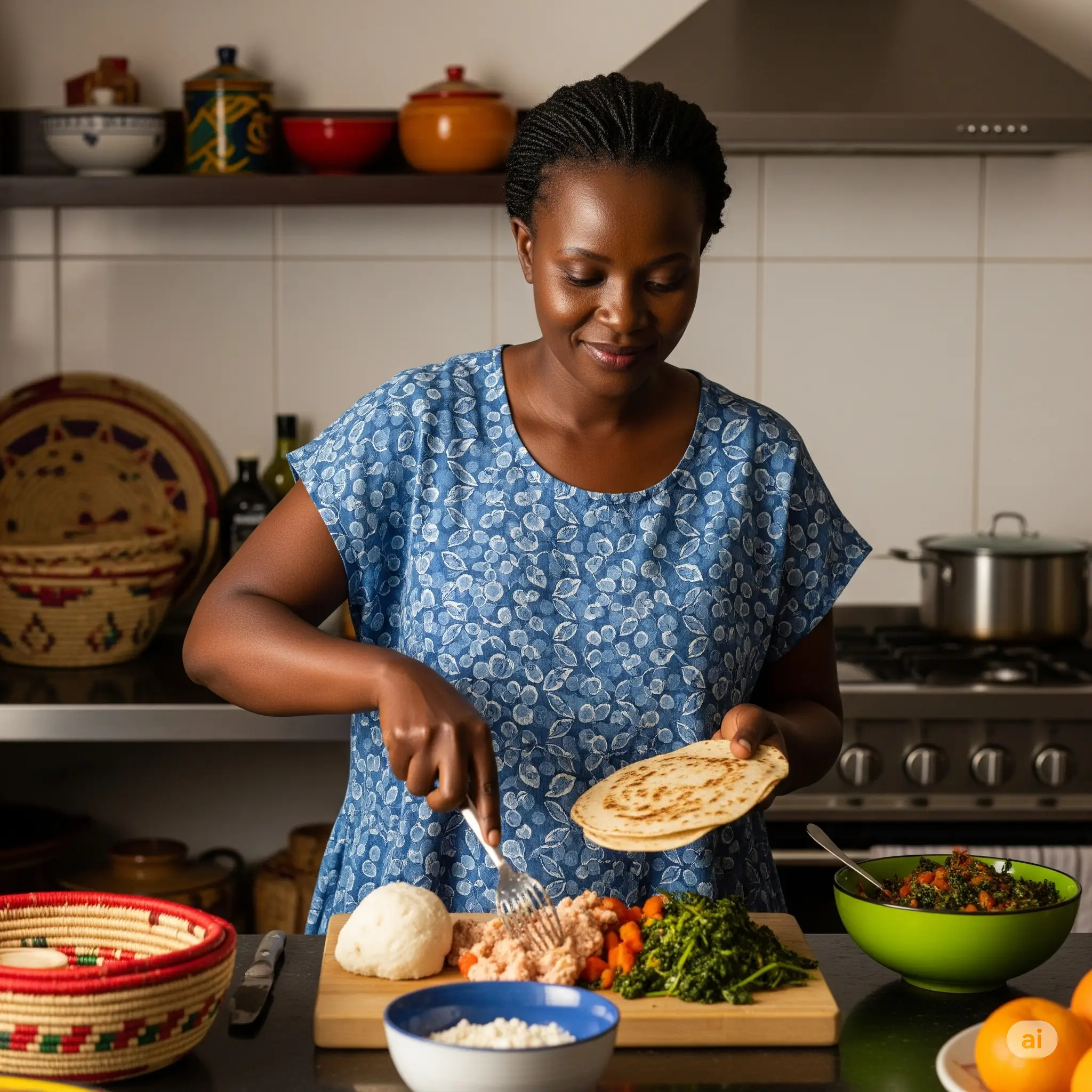
Chapatis are Kenya’s love language — warm, golden, and woven into every celebration. Growing up in Nairobi, they were my comfort, my culture. So, when my CGM showed that three chapatis spiked my blood sugar past 9 mmol/L — equivalent to 27 teaspoons of sugar — I felt betrayed. A 2019 Nutrients study explains why: refined wheat flour breaks down into glucose rapidly, especially without fiber or protein.
This isn’t just a Kenyan story. In Nigeria, fufu can cause similar spikes, as shared by Ada on X, who saw her glucose soar after a meal. Across Africa, our staple carbs — ugali, injera, sadza — can challenge blood sugar if not balanced.
Making Peace with My Plate
I refused to give up chapati. Instead, I learned to enjoy it wisely:
- Pair smartly – I eat chapati with protein (e.g., chicken curry) and fiber-rich sukuma wiki, slowing glucose absorption (American Journal of Clinical Nutrition, 2020).
- Walk after eating – A 10-minute walk cuts blood sugar spikes by 15%, per a 2022 Diabetes Research and Clinical Practice study.
- Portion with purpose – One chapati, not three, is my new norm.
- No solo carbs – Eating chapati alone is a sugar tsunami; paired right, it’s a treat.
Dr. Jason Fung’s The Diabetes Code taught me to see food as a tool, not a trap. Like Aisha from Ethiopia, who balanced injera with lentils and exercise, I eat with wisdom, not fear.
What I Wish We Were Taught
- Carbs aren’t evil — they need balance – Pairing reduces glucose spikes.
- Track to know – CGMs, used by diabetic communities in Kenya and South Africa, reveal your body’s response.
- Culture and health coexist – We can honor traditions while healing, as seen in Ghana’s diabetes-friendly jollof rice recipes.
I’m still proudly Kenyan, rolling chapatis with love, but now in harmony with my body.